The German Presence in the Eastern Townships
|
Labels:
research
The German Presence in the Eastern Townships by Nancy on Scribd

The Rev. James Reid, D.D., 1780-1865 by Richard Worden
|
Labels:
Church of England,
Frelighsburg,
Philipsburg,
worden
THE REV. JAMES REID, D.D., 1780 – 1865
 James Reid was a man with three careers. He was born near Dunkeld, Perthshire, Scotland, located in an area known as “Big Tree Country” to Gaelic speaking Presbyterian parents. When he was a young man he began to follow an evangelical Congregationalist missionary movement. Before being sent to Glengarry, Upper Canada, Reid received limited theological training followed by ordination in 1806. He found the area already well served by clergy and moved to Martintown, Upper Canada where he built a church and gathered a small congregation. Reid soon faced financial difficulties and took up teaching in Cornwall, married (1810) Isabella McDermid, 1786-1868, and the first of eight children was born. A meeting with a friend resulted in Reid being recommended to take a school in Frelighsburgh, Lower Canada (1812) where he came under the influence of the Rev. James Stewart of Holy Trinity Church.
Rev. Stewart encouraged James Reid to consider the ministry of the Church of England. Reid was prepared for Anglican ordination (1816) by the Rev. C. C. Cotton, of Dunham and was appointed as Rev. Stewart’s curate and two years later was given the appointment of Holy Trinity Church and the church at Philipsburg. Reid’s third career spanned fifty years. He died following a stroke two years before the birth of Canada.
James Reid was a man with three careers. He was born near Dunkeld, Perthshire, Scotland, located in an area known as “Big Tree Country” to Gaelic speaking Presbyterian parents. When he was a young man he began to follow an evangelical Congregationalist missionary movement. Before being sent to Glengarry, Upper Canada, Reid received limited theological training followed by ordination in 1806. He found the area already well served by clergy and moved to Martintown, Upper Canada where he built a church and gathered a small congregation. Reid soon faced financial difficulties and took up teaching in Cornwall, married (1810) Isabella McDermid, 1786-1868, and the first of eight children was born. A meeting with a friend resulted in Reid being recommended to take a school in Frelighsburgh, Lower Canada (1812) where he came under the influence of the Rev. James Stewart of Holy Trinity Church.
Rev. Stewart encouraged James Reid to consider the ministry of the Church of England. Reid was prepared for Anglican ordination (1816) by the Rev. C. C. Cotton, of Dunham and was appointed as Rev. Stewart’s curate and two years later was given the appointment of Holy Trinity Church and the church at Philipsburg. Reid’s third career spanned fifty years. He died following a stroke two years before the birth of Canada.
Rev. Reid’s ministry took place in the old church built by Rev. Stewart. The family lived in a drafty cold parsonage which Rev. Reid personally spent his own money to maintain. Clergy salaries were paid out of a fund which was slated to end and congregations were expected to financially support their clergy – a task which was completely foreign. The Reid family had a modest farm operation, held investments in stocks, and shopped wisely.
Rev. Reid was an avid reader and writer. He subscribed to newspapers (both church and secular), read novels, published three books, and a host of articles, essays, comments to newspaper editors, letters to family members, fellow clergy, politicians, and sermons. He also wrote a journal in which he recorded daily events and his own thoughts about a wide range of topics. The journals numbered 36 and only four survived his death as he burned them thinking they were of no value. Reid’s writings show him as the chronicler of his age – an age of population influx into the Eastern Townships mainly from the U. S. A., a time of indifference to the church, religious rivalry from Methodists and Adventists, uncertainty for the survival of the Church of England, extreme weather conditions, alcohol and opium abuse, the War of 1812, the Rebellion of 1837, and a lack of respect for conservative values. The writings also portray Reid as a generous supporter of his family to whom he lent money and assisted with the gifts of farm animals. He kept in constant contact with his children: Charles Peter, 1811-1888, who was a Church of England minister at Sherbrooke; John Hugh, 1813-1864, who in 1863 joined the US Union Army as a wagon master and died in the prison at Andersonville, Georgia; 1817 infant daughter died; Isabella Christina, 1818-1819; John Malcolm, 1820-1850, who died at Copper’s Well, Mississippi; James Stewart, 1823-1866, who farmed at Brome; Jane, 1825-1901; and Nancy, 1828-1856.
Rev. Reid was guaranteed a pension if he retired; however, his successor’s salary would be totally raised by the congregations. The fear of such a loss and burden kept Reid working until he died though he did have an assistant which helped the congregations in the transition of the minister’s stipend coming from missionary support to total local support. Philipsburg eventually acquired its own minister and Holy Trinity was expanded by two school house congregations.
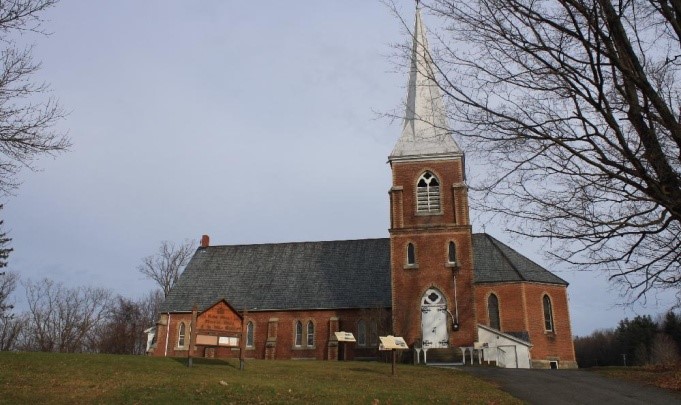
The wooden church building of Rev. Charles Stewart was removed in 1880 and replaced by the magnificent brick building that graces the Town of Frelighsburgh. Rev. and Mrs. Reid’s daughter, Jane, gave the church a gift to purchase chairs thus avoiding the practice of families paying an annual rent for a pew in order to attend worship. She wanted people of all means to be able to freely worship. Jane Reid knew intimately the financial worries of her father. The life span of the Rev. Dr. James Reid began with the American Revolution and ended just as Confederation was dawning. He witnessed the growing communities of the Eastern Townships and many world events: the abolition of Christianity in France, the abolition of slavery, the Battle of Waterloo, the Millerite prophecy, the Irish Potato Famine, the first postage stamp, the choice of Ottawa as a future capital city, Darwin’s Origin of Species, Abraham Lincoln, the American Civil War, and in 1864 thinking that his life was uneventful he burned 32 volumes of his diary.


Resources:
Brief History of the Bishop Stewart Memorial Church Frelighsburg, Quebec. http://stjamesanglican.ca/frelighsburg.html
Reisner, M. E. The Diary of a Country Clergyman, 1848 – 1851 James Reid. Montreal & Kingston: McGill-Queen’s University Press, 2000.
In the desert places of the wilderness: The Frontier Thesis and the Anglican Church in the Eastern Townships,1799-1831
Reid's Experiences https://www.scribd.com/document/353982493/Reid-s-Experiences
 James Reid was a man with three careers. He was born near Dunkeld, Perthshire, Scotland, located in an area known as “Big Tree Country” to Gaelic speaking Presbyterian parents. When he was a young man he began to follow an evangelical Congregationalist missionary movement. Before being sent to Glengarry, Upper Canada, Reid received limited theological training followed by ordination in 1806. He found the area already well served by clergy and moved to Martintown, Upper Canada where he built a church and gathered a small congregation. Reid soon faced financial difficulties and took up teaching in Cornwall, married (1810) Isabella McDermid, 1786-1868, and the first of eight children was born. A meeting with a friend resulted in Reid being recommended to take a school in Frelighsburgh, Lower Canada (1812) where he came under the influence of the Rev. James Stewart of Holy Trinity Church.
Rev. Stewart encouraged James Reid to consider the ministry of the Church of England. Reid was prepared for Anglican ordination (1816) by the Rev. C. C. Cotton, of Dunham and was appointed as Rev. Stewart’s curate and two years later was given the appointment of Holy Trinity Church and the church at Philipsburg. Reid’s third career spanned fifty years. He died following a stroke two years before the birth of Canada.
James Reid was a man with three careers. He was born near Dunkeld, Perthshire, Scotland, located in an area known as “Big Tree Country” to Gaelic speaking Presbyterian parents. When he was a young man he began to follow an evangelical Congregationalist missionary movement. Before being sent to Glengarry, Upper Canada, Reid received limited theological training followed by ordination in 1806. He found the area already well served by clergy and moved to Martintown, Upper Canada where he built a church and gathered a small congregation. Reid soon faced financial difficulties and took up teaching in Cornwall, married (1810) Isabella McDermid, 1786-1868, and the first of eight children was born. A meeting with a friend resulted in Reid being recommended to take a school in Frelighsburgh, Lower Canada (1812) where he came under the influence of the Rev. James Stewart of Holy Trinity Church.
Rev. Stewart encouraged James Reid to consider the ministry of the Church of England. Reid was prepared for Anglican ordination (1816) by the Rev. C. C. Cotton, of Dunham and was appointed as Rev. Stewart’s curate and two years later was given the appointment of Holy Trinity Church and the church at Philipsburg. Reid’s third career spanned fifty years. He died following a stroke two years before the birth of Canada.Rev. Reid’s ministry took place in the old church built by Rev. Stewart. The family lived in a drafty cold parsonage which Rev. Reid personally spent his own money to maintain. Clergy salaries were paid out of a fund which was slated to end and congregations were expected to financially support their clergy – a task which was completely foreign. The Reid family had a modest farm operation, held investments in stocks, and shopped wisely.
Rev. Reid was an avid reader and writer. He subscribed to newspapers (both church and secular), read novels, published three books, and a host of articles, essays, comments to newspaper editors, letters to family members, fellow clergy, politicians, and sermons. He also wrote a journal in which he recorded daily events and his own thoughts about a wide range of topics. The journals numbered 36 and only four survived his death as he burned them thinking they were of no value. Reid’s writings show him as the chronicler of his age – an age of population influx into the Eastern Townships mainly from the U. S. A., a time of indifference to the church, religious rivalry from Methodists and Adventists, uncertainty for the survival of the Church of England, extreme weather conditions, alcohol and opium abuse, the War of 1812, the Rebellion of 1837, and a lack of respect for conservative values. The writings also portray Reid as a generous supporter of his family to whom he lent money and assisted with the gifts of farm animals. He kept in constant contact with his children: Charles Peter, 1811-1888, who was a Church of England minister at Sherbrooke; John Hugh, 1813-1864, who in 1863 joined the US Union Army as a wagon master and died in the prison at Andersonville, Georgia; 1817 infant daughter died; Isabella Christina, 1818-1819; John Malcolm, 1820-1850, who died at Copper’s Well, Mississippi; James Stewart, 1823-1866, who farmed at Brome; Jane, 1825-1901; and Nancy, 1828-1856.
Rev. Reid was guaranteed a pension if he retired; however, his successor’s salary would be totally raised by the congregations. The fear of such a loss and burden kept Reid working until he died though he did have an assistant which helped the congregations in the transition of the minister’s stipend coming from missionary support to total local support. Philipsburg eventually acquired its own minister and Holy Trinity was expanded by two school house congregations.
The wooden church building of Rev. Charles Stewart was removed in 1880 and replaced by the magnificent brick building that graces the Town of Frelighsburgh. Rev. and Mrs. Reid’s daughter, Jane, gave the church a gift to purchase chairs thus avoiding the practice of families paying an annual rent for a pew in order to attend worship. She wanted people of all means to be able to freely worship. Jane Reid knew intimately the financial worries of her father. The life span of the Rev. Dr. James Reid began with the American Revolution and ended just as Confederation was dawning. He witnessed the growing communities of the Eastern Townships and many world events: the abolition of Christianity in France, the abolition of slavery, the Battle of Waterloo, the Millerite prophecy, the Irish Potato Famine, the first postage stamp, the choice of Ottawa as a future capital city, Darwin’s Origin of Species, Abraham Lincoln, the American Civil War, and in 1864 thinking that his life was uneventful he burned 32 volumes of his diary.


Resources:
Brief History of the Bishop Stewart Memorial Church Frelighsburg, Quebec. http://stjamesanglican.ca/frelighsburg.html
Reisner, M. E. The Diary of a Country Clergyman, 1848 – 1851 James Reid. Montreal & Kingston: McGill-Queen’s University Press, 2000.
In the desert places of the wilderness: The Frontier Thesis and the Anglican Church in the Eastern Townships,1799-1831
Reid's Experiences https://www.scribd.com/document/353982493/Reid-s-Experiences
Taken From Looking at History Blog: Missisquoi by Nancy on Scribd
|
Labels:
Missisquoi
Taken From Looking at History Blog: Missisquoi by Nancy on Scribd
Priest Cotton of St. Armand and Dunham, 1804-1848 by Richard Worden
|
Labels:
Church of England,
Dunham,
Saint Armand,
worden
PRIEST COTTON OF ST. ARMAND AND DUNHAM, 1804-1848
The 150th anniversary of Canada celebrates the efforts of many men, women, children, soldiers, politicians, and visionaries. Spectacular events also contribute: the Wolfe – Montcalm face-off on the Plains of Abraham, the American Revolution, the War of 1812, the Fenian Raids, the Lower Canada Rebellion, and the frontier settlers of the Eastern Townships. The settlers were branded as squatters but they insisted that they were not sojourners. The resolve to create a new life was supported by the presence of the church through courageous clergy – fine buildings would come later.
Among the clergy who came to Missisquoi Bay was the Rev. Charles Caleb Cotton of the Church of England (Anglican). It was over twenty years since the first families arrived in the Bay area and many newcomers were arriving. The area was briefly served by two short terms missionaries (Robert Quirk Short and James Marmaduke Tunstall) with little success. Cotton held church services wherever it was possible, boarded with a family, and found the people to lack interest and piety. He lasted four years and moved on his own volition to nearby Dunham. The move brought a reprimand from the bishop whose duty it was to transfer the clergy.
Charles Caleb Cotton was born July 31, 1775 in Eton England. He was the oldest of thirteen children born to his school teacher father and Swiss mother whose father was a French professor at Oxford. Cotton graduated in 1797 and was immediately ordained a deacon. He soon moved to the United States where he taught school but the pay forced him to find church work which took him to New York, New Jersey, and Pennsylvania. 1804 found Cotton in Quebec City and the first priest to be ordained in the new Holy Trinity Cathedral. He was immediately assigned to work in the area of Missisquoi Bay (St. Armand and Caldwell Manor).
The move to Dunham was a challenge for Rev. Cotton. He encountered competition from Methodist and Baptist itinerant missionaries. He boarded with a family of eight in a two room cabin; cleared three homestead farms; a church building (All Saints) was erected in 1821.He established a Sunday School, baptized 617 people, married 656 couples, and buried 187 people. He tutored two men for the ministry (Rev. Micajah Townsend and Rev. James Reid). However, his 40 year ministry in Dunham was not without controversy as he once refused to bury a lady who received baptism from some other denomination and was thought to be eccentric in manner and speech. He was one of the few clergy to receive a stipend which meant that he did not have to depend on what money was locally raised.
Rev. Cotton married Drusilla Pettis (June 22 1814) with whom he had seven children. A son, Charles Edward Cotton, was a physician in Brome. Rev. Cotton baptized his grandson, Charles Stuart Cotton, in October 1842. He died October 9, 1848 and was buried in the cemetery of Holy Trinity Church, Cowansville.
 References
Brome and Knowlton Church of England in Canada St John & St Peter 1842- 1879, Image 12, Folio 6.
Millman, Thomas R. “COTTON, CHARLES CALEB,” in Dictionary of Canadian Biography, vol. 7, University of Toronto/Université Laval, 2003–, accessed April 26, 2017, http://www.biographi.ca/en/bio/cotton_charles_caleb_7E.html.
References
Brome and Knowlton Church of England in Canada St John & St Peter 1842- 1879, Image 12, Folio 6.
Millman, Thomas R. “COTTON, CHARLES CALEB,” in Dictionary of Canadian Biography, vol. 7, University of Toronto/Université Laval, 2003–, accessed April 26, 2017, http://www.biographi.ca/en/bio/cotton_charles_caleb_7E.html.
Thanks to Richard Worden
The 150th anniversary of Canada celebrates the efforts of many men, women, children, soldiers, politicians, and visionaries. Spectacular events also contribute: the Wolfe – Montcalm face-off on the Plains of Abraham, the American Revolution, the War of 1812, the Fenian Raids, the Lower Canada Rebellion, and the frontier settlers of the Eastern Townships. The settlers were branded as squatters but they insisted that they were not sojourners. The resolve to create a new life was supported by the presence of the church through courageous clergy – fine buildings would come later.
Among the clergy who came to Missisquoi Bay was the Rev. Charles Caleb Cotton of the Church of England (Anglican). It was over twenty years since the first families arrived in the Bay area and many newcomers were arriving. The area was briefly served by two short terms missionaries (Robert Quirk Short and James Marmaduke Tunstall) with little success. Cotton held church services wherever it was possible, boarded with a family, and found the people to lack interest and piety. He lasted four years and moved on his own volition to nearby Dunham. The move brought a reprimand from the bishop whose duty it was to transfer the clergy.
Charles Caleb Cotton was born July 31, 1775 in Eton England. He was the oldest of thirteen children born to his school teacher father and Swiss mother whose father was a French professor at Oxford. Cotton graduated in 1797 and was immediately ordained a deacon. He soon moved to the United States where he taught school but the pay forced him to find church work which took him to New York, New Jersey, and Pennsylvania. 1804 found Cotton in Quebec City and the first priest to be ordained in the new Holy Trinity Cathedral. He was immediately assigned to work in the area of Missisquoi Bay (St. Armand and Caldwell Manor).
The move to Dunham was a challenge for Rev. Cotton. He encountered competition from Methodist and Baptist itinerant missionaries. He boarded with a family of eight in a two room cabin; cleared three homestead farms; a church building (All Saints) was erected in 1821.He established a Sunday School, baptized 617 people, married 656 couples, and buried 187 people. He tutored two men for the ministry (Rev. Micajah Townsend and Rev. James Reid). However, his 40 year ministry in Dunham was not without controversy as he once refused to bury a lady who received baptism from some other denomination and was thought to be eccentric in manner and speech. He was one of the few clergy to receive a stipend which meant that he did not have to depend on what money was locally raised.
Rev. Cotton married Drusilla Pettis (June 22 1814) with whom he had seven children. A son, Charles Edward Cotton, was a physician in Brome. Rev. Cotton baptized his grandson, Charles Stuart Cotton, in October 1842. He died October 9, 1848 and was buried in the cemetery of Holy Trinity Church, Cowansville.

Thanks to Richard Worden
The Eastern Townships, a pictorial record : historical prints and illustrations of the Eastern Townships
|
Labels:
books,
Philipsburg,
Saint Armand,
Stanbridge
A few images are from the Missisquoi county area, the entire book may be viewed here
http://bit.ly/2q6uVAc


http://bit.ly/2q6uVAc


Subscribe to:
Posts (Atom)